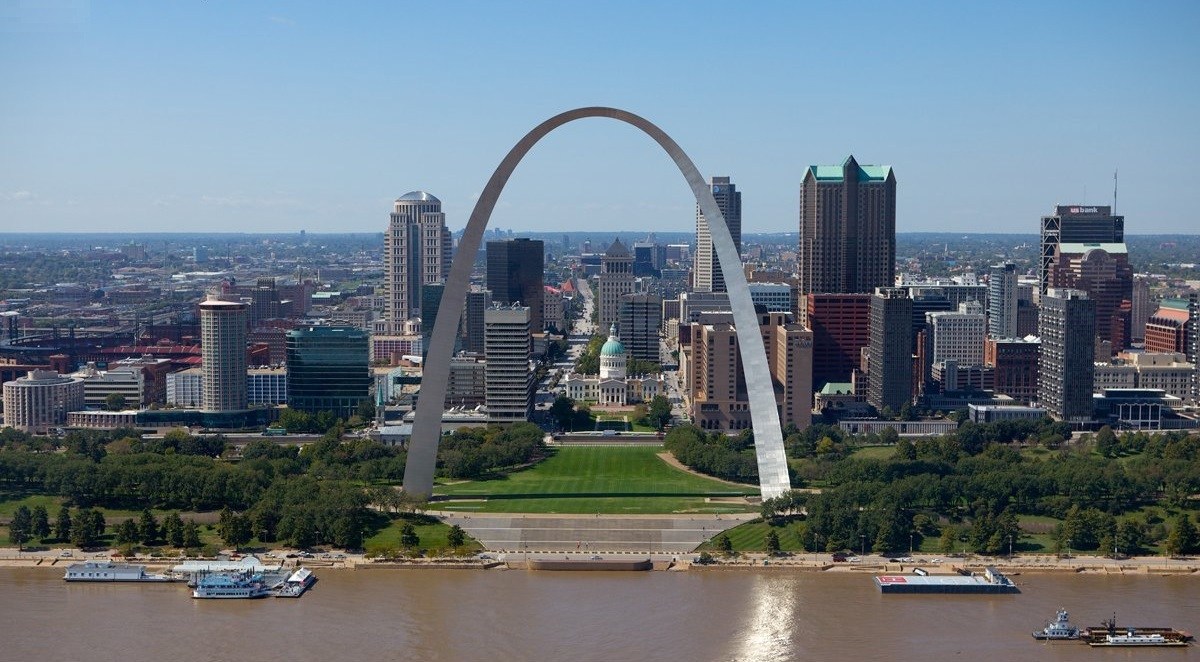
The Gateway Arch is a 630-foot (192 m) monument in St. Louis in the U.S. state of Missouri. Clad in stainless steel and built in the form of an inverted, weighted catenary arch, it is the world's tallest arch, the tallest monument in the Western Hemisphere, and Missouri's tallest accessible building. Built as a monument to the westward expansion of the United States, it is the centerpiece of the Jefferson National Expansion Memorial and has become an internationally famous symbol of St. Louis. The arch sits at the site of St. Louis' founding on the west bank of the Mississippi River. The Gateway Arch was designed by Finnish-American architect Eero Saarinen and German-American structural engineer Hannskarl Bandel in 1947. Construction began on February 12, 1963, and was completed on October 28, 1965, for $13 million (equivalent to $180 million in 2013). The monument opened to the public on June 10, 1967. Physical characteristics Both the width and height of the arch are 630 feet (192 m). The arch is the tallest memorial in the United States and the tallest stainless steel monument in the world. The cross-sections of the arch's legs are equilateral triangles, narrowing from 54 feet (16 m) per side at the bases to 17 feet (5.2 m) per side at the top. Each wall consists of a stainless steel skin covering a sandwich of two carbon-steel walls with reinforced concrete in the middle from ground level to 300 feet (91 m), with carbon steel to the peak. The arch is hollow to accommodate an unique tram system that takes visitors to an observation deck at the top. The structural load is supported by a stressed-skin design. Each leg is embedded in 25,980 short tons (23,570 t) of concrete 44 feet (13 m) thick and 60 feet (18 m) deep. Twenty feet (6.1 m) of the foundation is in bedrock. The arch is resistant to earthquakes and is designed to sway up to 9 inches (23 cm) in either direction while withstanding winds up to 150 miles per hour (240 km/h). The structure weighs 42,878 short tons (38,898 t), of which concrete composes 25,980 short tons (23,570 t); structural steel interior, 2,157 short tons (1,957 t); and the stainless steel panels that cover the exterior of the arch, 886 short tons (804 t). This amount of stainless steel is the most used in any one project in history.The base of each leg at ground level had to have an engineering tolerance of 1⁄64 inch (0.40 mm) or the two legs would not meet at the top Design competition (1945–1948) In November 1944, Smith discussed with Newton Drury, the National Park Service Director, the design of the memorial, asserting that the memorial should be "transcending in spiritual and aesthetic values," best represented by "one central feature: a single shaft, a building, an arch, or something else that would symbolize American culture and civilization." The idea of an architectural competition to determine the design of the memorial was favored at the inaugural meeting of the Jefferson National Expansion Memorial Association (JNEMA), which planned to award cash for the best design. In January 1945, the JNEMA officially announced a two-stage design competition that would cost $225,000 to organize. Smith and the JNEMA struggled to raise the funds, garnering only a third of the required total by June 1945. Then mayor Aloys Kaufmann feared that the lack of public support would lead officials to abandon hope in the project. The passage of a year brought little success, and Smith frantically underwrote the remaining $40,000 in May 1946. By June, Smith found others to assume portions of his underwriting, with $17,000 remaining under his sponsorship. In February 1947, the underwriters were compensated, and the fund stood over $231,199. Saarinen's team included himself as designer, J. Henderson Barr as associate designer, and Dan Kiley as landscape architect, as well as Lily Swann Saarinen as sculptor and Alexander Girard as painter. In the first stage of the competition, Swedish sculptor Carl Milles advised Saarinen to change the bases of each leg to triangles instead of squares. Saarinen said that he "worked at first with mathematical shapes, but finally adjusted it according to the eye." At submission, Saarinen's plans laid out the arch at 509 feet (155 m) tall and 592 feet (180 m) wide from center to center of the triangle bases. On September 1, 1947, submissions for the first stage were received by the jury. The submissions were labeled by numbers only, and the names of the designers were kept anonymous. Upon four days of deliberation, the jury narrowed down the 172 submissions, which included Saarinen's father Eliel, to five finalists, and announced the corresponding numbers to the media on September 27. Saarinen's design (#144) was among the finalists, and comments written on it included "relevant, beautiful, perhaps inspired would be the right word" (Roland Wank) and "an abstract form peculiarly happy in its symbolism" (Charles Nagel). Hare questioned the feasibility of the design but appreciated the thoughtfulness behind it. Local St. Louis architect Harris Armstrong was also one of the finalists. The secretary who sent out the telegrams informing finalists of their advancement mistakenly sent one to Eliel rather than Eero. The family celebrated with champagne, and two hours later, a competition representative called to correct the mistake. Eliel 'broke out a second bottle of champagne' to toast his son. Public access In April 1965, three million tourists were expected to visit the arch after completion; 619,763 tourists visited the top of the arch in its first year open. On January 15, 1969, a visitor from Nashville, Tennessee became the one-millionth person to reach the observation area; the ten-millionth person ascended to the top on August 24, 1979. In 1974, the arch was ranked fourth on a list of "most-visited man-made attraction". The Gateway Arch is one of the most visited tourist attractions in the world with over four million visitors annually, of which around one million travel to the top. The arch was listed as a National Historic Landmark on June 2, 1987, and is also listed on the National Register of Historic Places. Visitor center The underground visitor center for the arch was designed as part of the National Park Service's Mission 66 program. The 70,000-square-foot (6,500 m2) center is located directly below the arch, between its legs. Although construction on the visitor center began at the same time as construction for the arch itself, it did not conclude until 1976 because of insufficient funding; however, the center opened with several exhibits on June 10, 1967. Access to the visitor center is provided through ramps adjacent to each leg of the arch. Observation area Near the top of the Arch, passengers exit the tram compartment and climb a slight grade to enter the observation area. This arched deck, 65 feet (20 m) long and 7 feet (2.1 m) wide, can hold about 160 people, four trams' worth. Sixteen windows per side, each measuring 7 by 27 inches (180 mm × 690 mm), offer views up to 30 miles (48 km): to the east across the Mississippi River and southern Illinois with its prominent Mississippian culture mounds at Cahokia Mounds, and to the west over the city of St. Louis and St. Louis County beyond. Symbolism and culture Built as a monument to the westward expansion of the United States, the arch typifies "the pioneer spirit of the men and women who won the West, and those of a latter day to strive on other frontiers." The arch has become the iconic image of St. Louis, appearing in many parts of city culture. In 1968, three years after the monument's opening, the St. Louis phone directory contained 65 corporations with "Gateway" in their title and 17 with "Arch". Arches also appeared over gas stations and drive-in restaurants. In the 1970s, a local sports team adopted the name "Fighting Arches"; St. Louis Community College would later (when consolidating all athletic programs under a single banner) name its sports teams "Archers". Robert S. Chandler, an NPS superintendent, said, "Most [visitors] are awed by the size and scale of the Arch, but they don't understand what it's all about ... Too many people see it as just a symbol of the city of St. Louis." The arch has also appeared as a symbol of the State of Missouri. On November 22, 2002, at the Missouri State Capitol, Lori Hauser Holden, wife of then Governor Bob Holden uncovered the winning design for a Missouri coin design competition as part of the Fifty States Commemorative Coin Program. Designed by watercolorist Paul Jackson, the coin portrays "three members of the Lewis and Clark expedition paddling a boat on the Missouri River upon returning to St. Louis" with the arch as the backdrop. Holden said that the arch was "a symbol for the entire state ... Four million visitors each year see the Arch. [The coin] will help make it even more loved worldwide." A special license plate designed by Arnold Worldwide featured the arch, labeled with "Gateway to the West." Profits earned from selling the plates would fund the museum and other educational components of the arch

Guerrilla Dating / Missouri / St. Louis

St. Louis Dating: Alternatives to Hinge, Bumble, Tinder and JDate.

Find a first-meeting spot

Photo: Sam valadi / Wikimedia Commons · CC BY 2.0 · Resized and cropped

Animated Guerrilla Dating card: a crosshair locks onto a heart, then www.GuerrillaDating.com/Name appearsCustomize your card with your name

Apps can introduce people, and they aren't everyone's preferred starting point. Guerrilla Dating offers a different tool: a personal page and a card you can download and print yourself. It isn't a local matchmaking service and doesn't guarantee dates.

Still using an app? Offer your profile link only when the other person wants it. Keep the conversation on the app if that's their preference. Already exchanged numbers? A short, contextual first text can include the link without turning into a pitch.

Read the practical dating guides

St. Louis links Mississippi River symbolism with Forest Park’s cultural landscape and the botanical traditions of Shaw. The Gateway Arch provides one perspective on national history, while art, science, and planted environments offer others. Its dispersed attractions favor a neighborhood-focused plan over a crowded citywide checklist.

Choose the neighborhood first.

The Gateway Arch stands beside the Mississippi River at downtown’s eastern edge. Its grounds, museum, and tram experience are related but not interchangeable. Build the riverfront portion around the specific experience you want, accounting for current security procedures and individual accessibility needs before arrival.

Forest Park lies west of downtown and contains major cultural institutions, including the Saint Louis Art Museum and Science Center’s planetarium. Its size makes precise destination planning important. A park visit is not automatically a short walk between every institution, particularly in heat or winter weather.

The Missouri Botanical Garden occupies a distinct setting in the Shaw area, south of Forest Park. Its collections offer a designed landscape rather than the Arch’s riverfront or the park’s broad recreation space. Confirm current garden notices before assuming every conservatory, path, or special feature is available.

The shortlist / Public places, not pickup spots

Five places to begin.

Choose together, check the official visitor details, and keep the first meeting easy to leave. These are independently researched suggestions—not partnerships or reports of personal visits.

01

Downtown riverfront

Gateway Arch National Park

Connect the monument and museum with the Mississippi River landscape. Take time to compare details together. Observe carefully.

Check current official visitor guidance, access conditions, and any booking requirements before traveling; particular exhibits, programs, or facilities may change and should not be assumed available.

Official visitor information
02

Forest Park

Saint Louis Art Museum

Choose several galleries and compare their works with the museum’s monumental park setting. Take time to compare details together.

Check current official visitor guidance, access conditions, and any booking requirements before traveling; particular exhibits, programs, or facilities may change and should not be assumed available.

Official visitor information
03

West of downtown

Forest Park

Choose a focused landscape walk rather than attempting the entire park. Take time to compare details together. Observe carefully.

Check current official visitor guidance, access conditions, and any booking requirements before traveling; particular exhibits, programs, or facilities may change and should not be assumed available.

Official visitor information
04

Oakland Avenue and Forest Park

Saint Louis Science Center

Explore hands-on science and select any additional presentation according to shared interests. Take time to compare details together.

Check current official visitor guidance, access conditions, and any booking requirements before traveling; particular exhibits, programs, or facilities may change and should not be assumed available.

Official visitor information
05

Shaw

Missouri Botanical Garden

Compare designed gardens and plant collections through the changing seasons. Take time to compare details together. Observe carefully.

Check current official visitor guidance, access conditions, and any booking requirements before traveling; particular exhibits, programs, or facilities may change and should not be assumed available.

Official visitor information

A card isn't a pickup trick.

It's a way to leave an invitation after a mutual conversation. “I've enjoyed talking with you. Would you like my card?” Ask once. If they decline, accept it and move on. If they accept, let them read your page when they choose.

Don't interrupt someone who's working, wearing headphones or trying to leave. Don't block their path, follow them or insist on a response. The point is to give them a choice—not to take away the possibility of “no.”

Jesse Gilbert built Guerrilla Dating from his own Santa Monica experiment. Read his profile for his personal story; the recommendations above are editorial research.

A few useful questions.

Does Arch access automatically include the tram?

No. Treat the grounds, museum, and tram as distinct elements of the Gateway Arch experience. Review current National Park Service guidance and ticket instructions, including mobility limitations and security requirements, before planning a ride.

Can we see all of Forest Park casually?

Forest Park is extensive, with multiple major institutions and recreational areas. Select one destination and an appropriate nearby walk rather than assuming every museum, garden, and attraction fits comfortably into a single short outing.

Is the Botanical Garden inside Forest Park?

No. Missouri Botanical Garden occupies its own campus in the Shaw area, south of Forest Park. Check its current visitor arrangements separately, especially when planning conservatory access, special events, or particular garden features. Observe carefully.

What offers an indoor alternative?

Saint Louis Art Museum and Saint Louis Science Center offer different indoor cultural experiences around Forest Park. Check current galleries, presentations, and ticket arrangements; special programs may have requirements separate from the main institution.

More places to connect in Missouri.

Guerrilla Dating · Your next introduction

Leave a way to find you.

Your own page. A card you can download and print. One invitation, on their terms—not another swipe.

Jesse Gilbert's Guerrilla Dating card